Where Our Treasure Is
The affections of our hearts reveal what or who we are trusting in
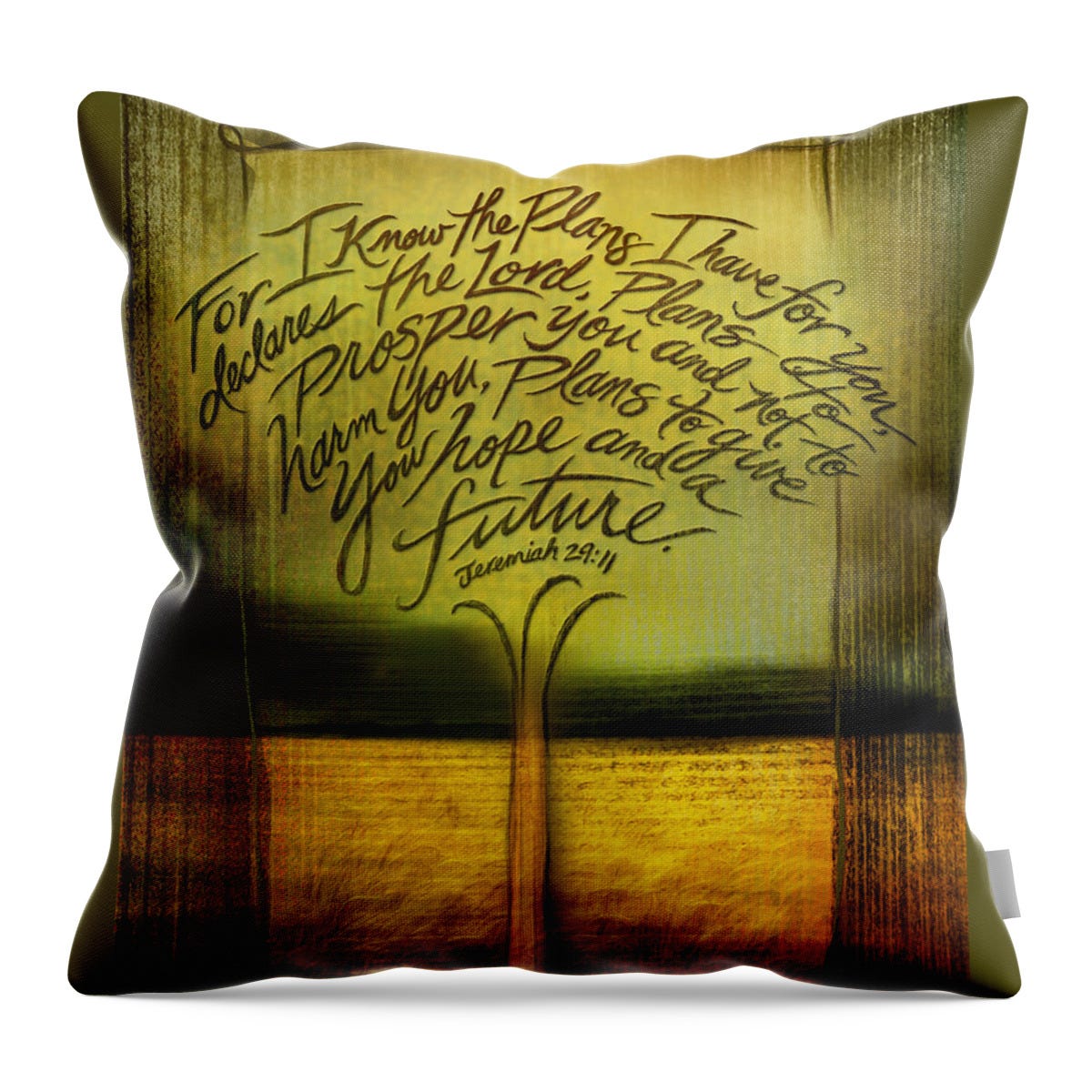
View
I’m not sure if America can be considered a Christian nation, or even what that descriptor means. But judging only from throw pillows, Christianity persists at least as a large cultural influence. You may be thinking that this may not be the best indicator, and I would agree. But it tells us something about ourselves and how many think of our faith and something about how the rest of the culture views those of us who believe and practice Christianity.
Our favorite bible passages usually are promises, sometimes we leave the context out, or sometimes we are unaware of the context. We like the promise part.
We are just coming out of graduation season, and many have heard in this month of May the patron saint of out of context passages - Jeremiah 29:11
“For I know the plans I have for you,” declares the Lord, “plans to prosper you and not to harm you, plans to give you hope and a future.”
At graduation and similar occasions, this is taken to be a blanket promise meaning you will never be harmed, always have hope, and always be pointed toward a fruitful future. Which, given the graduation party setting, where students may not have a clear view of their future college or major or career or hometown, this can be received as a welcome promise to clear all that up and make you successful in the bargain. It may come as a surprise that Jeremiah, on the occasion of the destruction of Jerusalem and the exile of the people to another land, had something different in mind. Something more fitting to circumstances darker than a graduate’s (and, let’s face it, a graduate’s parents) anxiety about what form their middle class future might take.
On that theme, one of the most cited Old Testament passages in evangelical Christianity is 2 Chronicles 7:14 -
“If my people, who are called by my name, will humble themselves and pray and seek my face and turn from their wicked ways, then I will hear from heaven, and I will forgive their sin and heal their land.”
It may not be surprising, even to the religiously uninformed, that this verse is a favorite of American Christian Nationalists. Stripping the verse of the actual context, many traditional American Christians apply this verse to America. If Americans (my people), humble themselves and pray and turn from their wicked ways (insert all manner of culture war and identity politics statements here), then God will hear and forgive and heal their land (America). A moment or two of reflection might lead one to question the premise that a verse written 2500 years ago, give or take, is a promise to a nation formed 250 years ago. The promise is for those who follow God, including evangelical Christians of all nationalities, who humble themselves, pray, and seek His face. (Not necessarily for those who wield this verse against others). But anyway.
Christians Engaged is a conservative Christian organization that seeks to engage (conservative) Christians politically. They organized a marathon public reading of the entire bible. Participants included Marco Rubio, J.D. Vance, Pete Hegseth, Mike Johnson, Mike Pompeo, and Ben Carson. Perhaps not surprisingly, the president also participated, reading the above passage (again, not surprising) from the Oval Office. The president as representative, as avatar, of God’s blessing on America. This is the face of Christian Nationalism.
One does not need to be plugged in at all to the Christian community to have observed the significant overlap between the world of the Christian Nationalists and the world of MAGA and those who are supporters of our current President. Not all MAGA adherents are Christian Nationalists, but very few Christian Nationalists in America are not also adherents to the MAGA program and, by definition, supporters of the President.
The President being the representation of a Christian movement in America leads to some scrambling whenever he communicates something, shall we say, outside of the normal bounds of Christian doctrine. Here is just one example, which dropped on Easter morning.
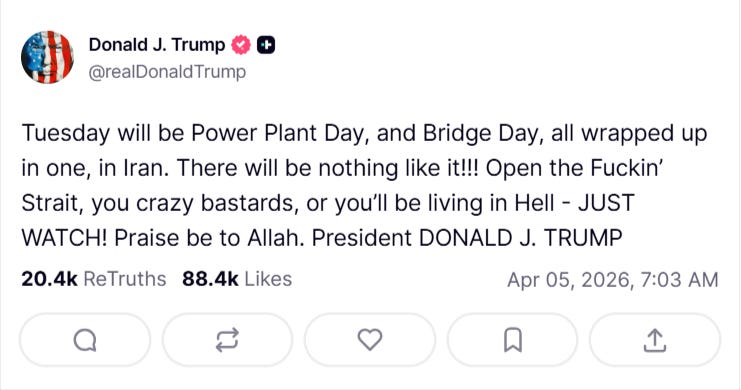
If having a President as the representation of American Christian nationalism is unusual, an American Pope is even more unusual. Shortly afterwards, at an evening prayer service, Leo IVX said in reference to the war in Iran, "It is here” (in the church) “that we find a bulwark against that delusion of omnipotence that surrounds us and is becoming increasingly unpredictable and aggressive," he said. "Even the holy Name of God, the God of life, is being dragged into discourses of death." I’m not a Catholic, but I have to agree with Leo on this one.
About a week after Easter, and after the negative reaction from his Easter message, the President posted a picture appearing to depict him as a divine healer of some sort.
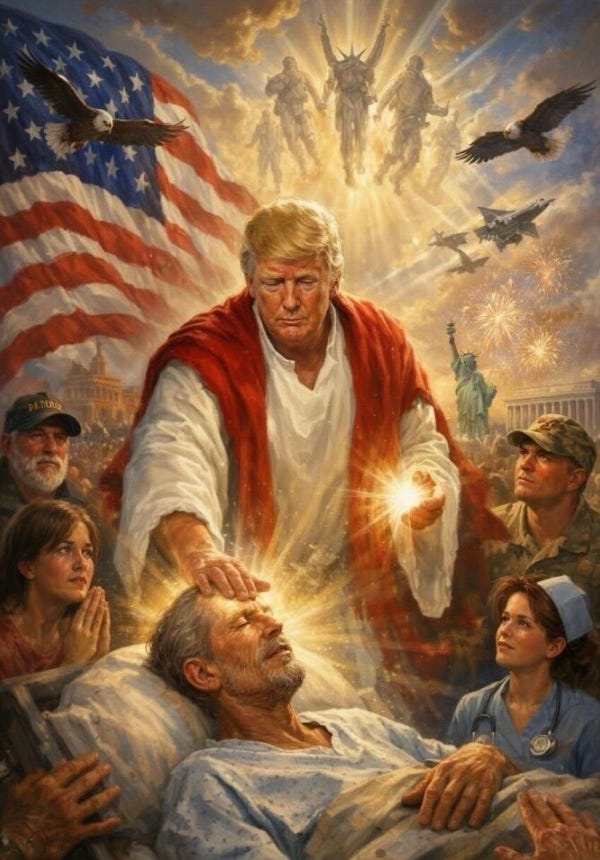
This provoked a backlash among even many MAGA diehards. The President removed the image and claimed it was simply him as a doctor. I don’t have this experience at my doctor’s office - divine light, adoration which appears indistinguishable from worship by those surrounding him, and strange imagery in the sky. Perhaps I should shop around.
Lest we think that this episode provoked a period of introspection for the most committed supporters of the President, on May 6, a 22-foot tall golden statue of President Trump was unveiled at the Trump National club in Doral, Florida.
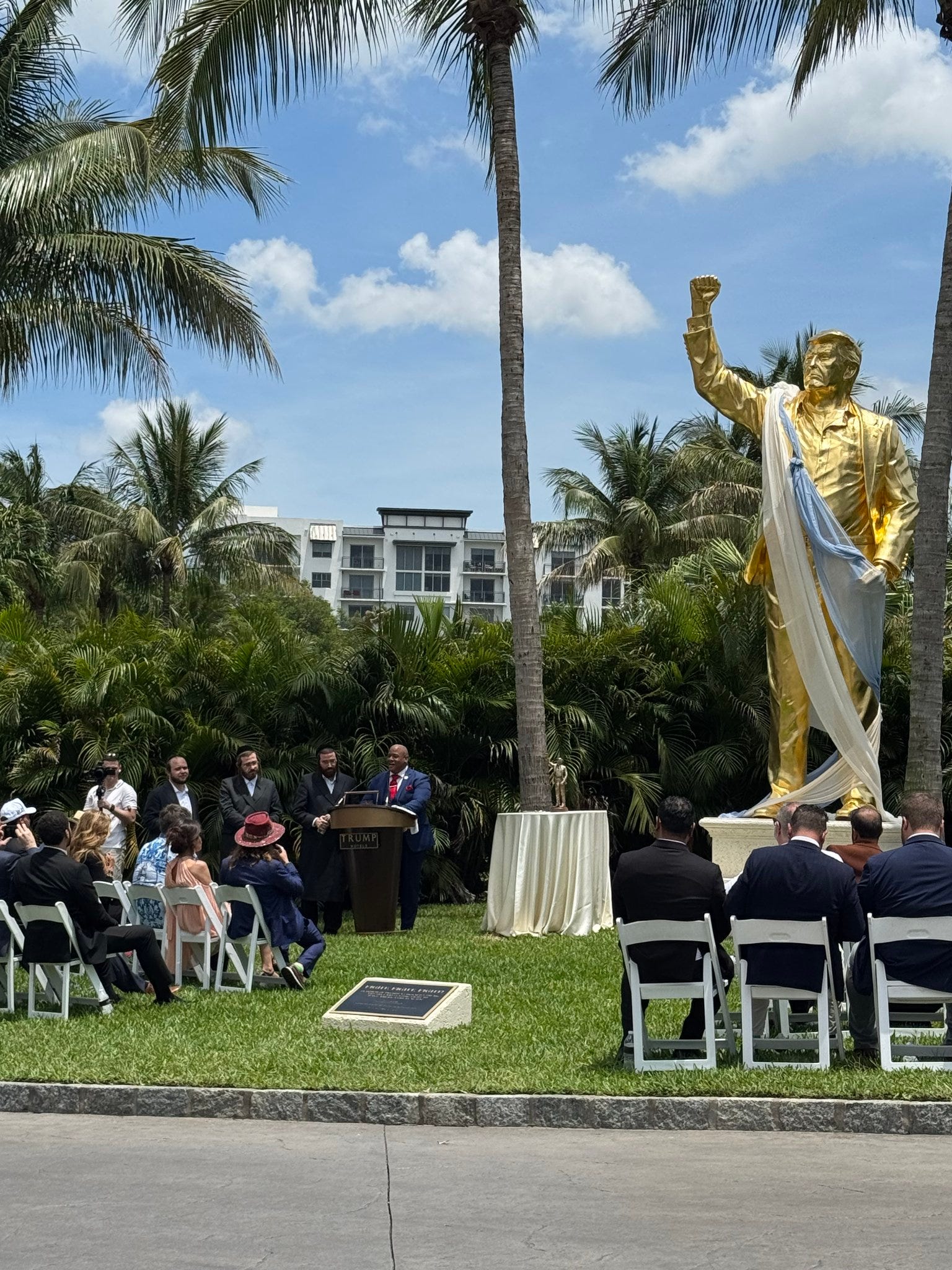
Pastor to the President, Mark Burns led the ceremony. On a contemporaneous social media post, Burns wrote,
Let me be clear: this is not a golden calf. We worship the Lord Jesus Christ and Him alone.
This statue is a celebration of life. It is a symbol of resilience, freedom, patriotism, strength, and the will power to keep fighting for the future of America.
It also stands as a reminder of the hand of God and His protection over President Trump’s life. Time and time again, when his life was threatened, God’s mercy prevailed.
Today was not just a ribbon cutting. It was the public display of a powerful movement that has spread across America and around the world.
My first response: whenever one feels the need to begin a statement explaining that the 22 foot tall golden statue is not a golden calf, one probably should ask why there may be a need for such an explanation. At any rate, we see the recurring theme, President Trump as the symbol of God’s movement and blessing on America.
Evidently unpersuaded, Pope Leo has been a consistent critic of the President, and the President has responded as he often responds to criticism.
Pope Leo XIV is one of the world’s most powerful critics of the U.S. war with Iran. In recent days, he has condemned the worship of mortals and money, the pitfalls of arrogance, and the “absurd and inhuman violence” unleashed by fighting that has further destabilized the Middle East.
His many admonishments over the past week appear to have reached President Trump, who responded to those calls for peace by scorching the first American-born pontiff on social media and then taking personal credit for Leo’s ascension to the papacy.
“Leo should be thankful because, as everyone knows, he was a shocking surprise,” Mr. Trump wrote in a lengthy social media post on Sunday night. “He wasn’t on any list to be Pope, and was only put there by the Church because he was an American, and they thought that would be the best way to deal with President Donald J. Trump. If I wasn’t in the White House, Leo wouldn’t be in the Vatican.”
New York Times - Trump Attacks Pope Leo as Too Liberal and ‘Weak on Crime’ - April 12, 2026
Again, I am not Catholic, but I would guess there might be some objection to the assertion that the Pope was selected out of deference to our President. This, however, is the order of priorities that emerges in all of these potential conflicts between President Trump and any criticism from any church or church leader. An implicit or explicit choice is offered, loyalty to the President or to the church, loyalty to President Trump or to the plain reading of Scripture, loyalty to a political leader or loyalty to what the church has taught and believed for centuries. Even the backlashes, representing some memory of a different set of priorities, fade in the face of this choice.
When the Pope subsequently made a statement against war (which reflects the teaching of the Catholic church), he was admonished and corrected by Vice President J.D. Vance.
“In the same way that it’s important for the vice president of the United States to be careful when I talk about matters of public policy, I think it’s very, very important for the pope to be careful when he talks about matters of theology,” Mr. Vance said.
New York Times - Vance Says the Pope Should Be More Careful When Talking About Theology - April 14, 2026
I’m sure the pope doesn’t need encouragement from the vice president regarding care in theological discussion. It is less a stay in your lane statement and more an attempt to define the lane. And, in keeping with the pattern, here is the definition of the lane - correct theology invariably corresponds to the policies of the Trump administration, at least in as much as they are discernable.
This, however, is the order of priorities that emerges in all of these potential conflicts between President Trump and any criticism from any church or church leader. An implicit or explicit choice is offered, loyalty to the President or to the church, loyalty to President Trump or to the plain reading of Scripture, loyalty to a political leader or loyalty to what the church has taught and believed for centuries.
A couple of weeks ago, on a completely different train of thought, I wrote about a trend of surprising God-related appearances in recent movies (including Black Bag and Hail Mary). I contrasted this recent trend with how the church has been consistently portrayed in movies, television, and books. I referenced the brilliant There Will Be Blood and Paul Thomas Anderson’s portrayal of Eli Sunday in particular, standing for the evangelical church in general.
It isn’t Anderson’s goal to give us a full accounting of Christianity in America and he may not be best suited to that task, but he does give us an account that is true to much of the history of the church in our country. In this telling, it is a hypocritical, shallow, false, and self-serving church and faith, merely instrumental in giving the good life, distinguishable from capitalism only in form and appearance.
Hypocritical, shallow, false, self-serving, merely instrumental, pointed toward the good life. I could say that this is true to much of the history of the church in our country - a church I am very much a part of and a church that often, usually out of popular view, isn’t those things. But it is this transactional outlook - the faith, scripture, the church, Jesus, existing to give us the good life, comfort & prosperity, sure, but also the security of being in the right and the ability to slay the enemies of the right (which just happen to be our enemies, which just happen to be the enemies of our political and cultural “allies) - that spans from Paul Thomas Anderson to throw pillows and graduation parties.
It is the articulated program of Christian Nationalism that the Christian cultural way of life is attained by gaining political and cultural power and using that power to enact it, not dissimilar to Eli Sunday’s agenda. But, with all deference to Paul Thomas Anderson, whatever comes from that isn’t in any historical, biblical, or theological sense Christian. It might represent a sort of Christian triumphalism, except that those two words don’t belong together. But this is what is trusted in, this is where the hope of Christian Nationalism lies.
Jesus taught us that where we locate our treasure, where we put our hopes and future and security, that is what orients our heart. It is what we think about, worry about, react to, value.
Do not store up for yourselves treasures on earth, where moths and vermin destroy, and where thieves break in and steal. But story up for yourselves treasures in heaven, where moths and vermin do not destroy, and where thieves do not break in and steal. For where your treasure is, there your heart will be also.
Matthew 6:19-21
This is where a transactional faith leads. Whatever the transaction, however successful the transaction, it is bound to the earth. It will disappoint. It can’t carry the weight of our hopes, our future, our security. It is not worthy of our love. It is, in a very real sense, in the most real sense, a golden calf. And, perhaps, here the true meaning of 2 Chronicles 7:14 applies. We should humble ourselves, pray, seek his face, and turn from this shallow, transactional, narrow, and false gospel. We may ask, as we pray, what storing up treasures in heaven looks like this day, this week. And, while we are at it, we should pray for our enemies, for those that oppose us or misunderstand us or slander us - while we repent of what may not be slander.
Links
Pope Leo XIV denounces the ‘delusion of omnipotence’ he says is fueling the U.S.-Israeli war in Iran - pbs.org - April 20, 2026
Pastor Mark Burns - x.com - May 6, 2026
Trump Attacks Pope Leo as Too Liberal and ‘Weak on Crime’ - NY Times - April 12, 2026
Vance Says the Pope Should Be More Careful When Talking About Theology - NY Times - April 14, 2026
God as the Plot Twist

Paul Thomas Anderson’s There Will Be Blood is considered one of the greatest movies of this century. The New York Times, in their list of greatest 21st Century films released last year, logs this 2007 film at number three. While The Guardian and Rolling Stone