God as the Plot Twist
Are there signs of God being represented in our culture as a positive, surprising, even exotic choice?
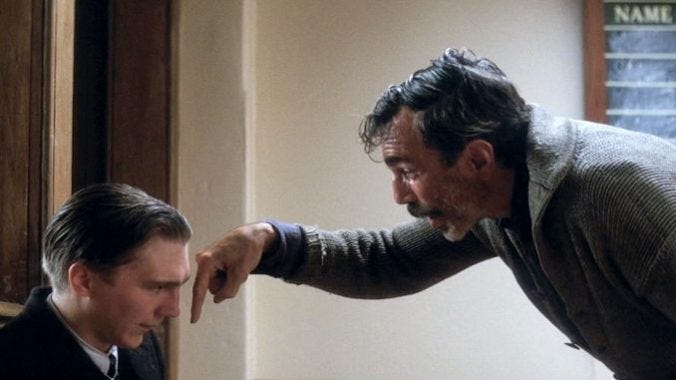
Paul Thomas Anderson’s There Will Be Blood is considered one of the greatest movies of this century. The New York Times, in their list of greatest 21st Century films released last year, logs this 2007 film at number three. While The Guardian and Rolling Stone have named it the century’s best. Central to the film is the portrayal of capitalism, embodied by the character of Daniel Plainview, played to Oscar winning effect by Daniel Day-Lewis. Plainview is predatory capitalism at it’s most predatory, it’s most driven, it’s most self-focused, and it’s most implacable.
The counterpoint to Plainview’s predatory capitalism is the portrayal of frontier Evangelical Christianity, in the character of Eli Sunday, played by Paul Dano. Sunday sees through Plainview’s exploitation of his community and church members, and serves as a foil - not to stop Plainview, just opposing him enough to still profit from Plainview’s increasing revenue and power. This parasitical rivalry comes to a head in one of the more memorable scenes in movie history. Certainly the most memorable scene involving bowling pins and milkshakes.
For the moment, it is PTA’s portrayal of this independent, evangelical Christianity that interests me. It is artful, thoughtful, true in many respects, but incomplete. It isn’t Anderson’s goal to give us a full accounting of Christianity in America and he may not be best suited to that task, but he does give us an account that is true to much of the history of the church in our country. In this telling, it is a hypocritical, shallow, false, and self-serving church and faith, merely instrumental in giving the good life, distinguishable from capitalism only in form and appearance. Too often the church has been all of these things, sometimes we have experienced them ourselves. Anderson’s portrayal of Christianity in America is more skillfully done and has more depth than many others, but it is hardly alone and shares the same theme as many other less artful, less thoughtful portrayals.
In this telling, it is a hypocritical, shallow, false, and self-serving church and faith, merely instrumental in giving the good life, distinguishable from capitalism only in form and appearance.
We need not wonder why cultural portrayals of faith and church are often negative. That is what many people, sadly, experience. But many others, outside of the view of much of our culture, have a completely different experience. Even so, our post-enlightenment world often sees religion as backward, superstitious, and, well, unenlightened. Perhaps that is beginning to be re-evaluated as our post-enlightenment world begins to lose faith in the fruits of the enlightenment.
Wake Up Dead Man, the 2025 installment of Rian Johnson’s Knives Out franchise, in many ways continues this theme. Monsignor Jefferson Wicks, played by Josh Brolin, is Eli Sunday, but driven by identity, power, and politics instead of money. Or, given the turns of the plot, I should remember that money is also on the list. He leads a very small, intentionally small, congregation, loyal to him as the one who has, at least in part, defined them. Wicks wants to keep his congregation “pure” by keeping everyone else out. In particular, he wants to keep a priest sent to Wick’s church, Father Jud Duplenticy, played by Josh O’Connor, as far out of power and influence as he can. Johnson’s portrayal of Wicks and his church as a backward, divisive, fearful, and hateful place - consonant with so many other portrayals - only heightens the genuine, imperfect, human, grace-filled faith of Father Duplenticy, the (surprising) main character.
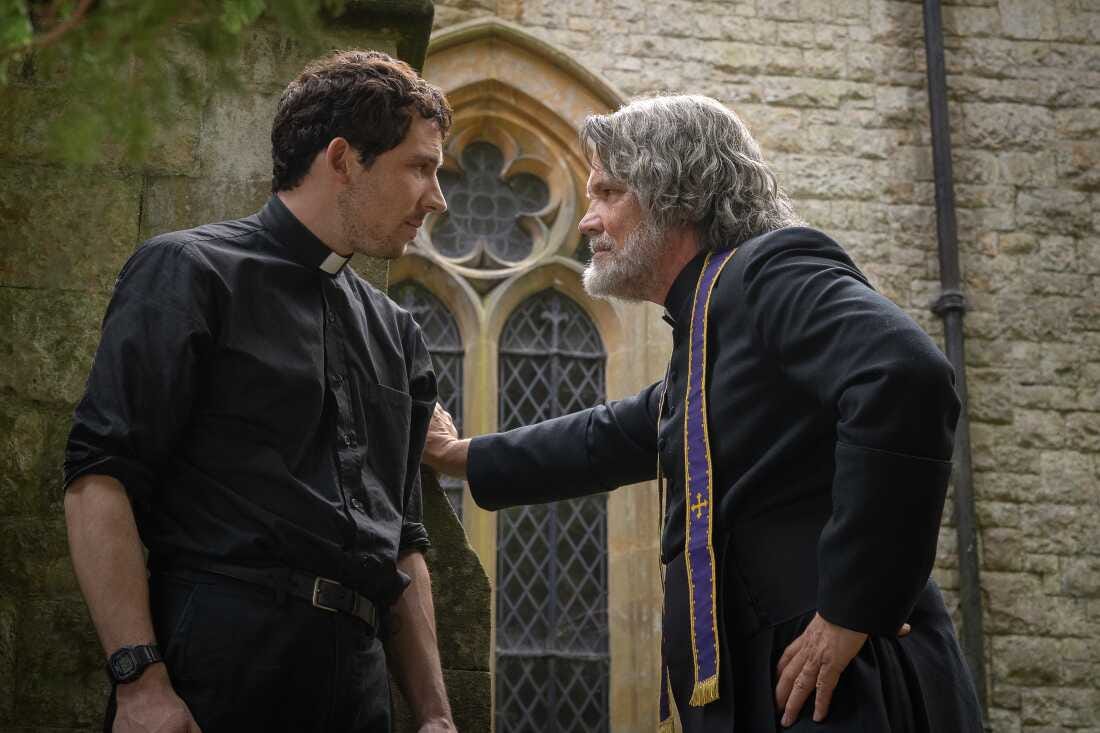
Duplenticy comes to faith, and the priesthood, as a result of his very personal experience of redemption and grace. And so, for him, redemption and grace is what the church is all about. For those who have experienced redemption and grace on a personal level, this is what the church tends to be about as well. It is the church that many in the wider culture do not see.
Duplenticy is the perfect companion for detective Benoit Blanc, the central recurring character in this franchise. Blanc is a good and decent man, finding truth and the justice that comes with it at all costs. And he is, or seems, far from faith. Father Duplenticy, seeing Blanc’s view of the church, says
“I take it you’re not a Catholic”. To which Blanc replies, “Ah, no. Proud Heretic. I kneel at the alter of the rational.”
Here is the enlightenment view of the church and the faith on full display. ‘I cannot be a person of faith and kneel at the alter of the rational’, which is true up to the point it is not. Or, perhaps it is true in a way that Blanc probably doesn’t intend. Blanc calls the church, the rituals, the scriptures, belief itself, simply storytelling.
He says, “I feel the grandeur, the... the mystery, the intended emotional effect. It's... And it's like someone has shone a story at me that I do not believe.”
He then lists many of the ills of the church, perceived or real, so often experienced and depicted in our culture. To which Duplenticy replies,
“You're right. It's storytelling. The rites and the rituals. Costumes, all of it. It's storytelling. I guess the question is, do these stories convince us of a lie? Or do they resonate with something deep inside us that's profoundly true, that we can't express any other way except storytelling?”
A remarkable conversation in the midst of a whodunnit. In the end, it is not only Blanc’s detective skills, it is his trust in the demonstrated goodness of Father Duplenticy, his trust in the genuineness and efficacy of his faith that helps solve the mystery. And it is the faith and grace that comes through Duplenticy that redeems and revives this dying church. It is, at least in part, the story of a struggle for what the church is, what faith is, how we see it, and how we enter into it. In the end, the church is where redemption, forgiveness, grace, and, yes, truth are found.
The search for the truth is at the heart of a very different 2025 movie, Steven Soderbergh’s Black Bag. This is a spy movie where, as is true for most spy movies, you aren’t supposed to know what everything means, who is telling the truth, who is lying to whom and why. Black Bag tells the story of the fictional power couple of British espionage. Michael Fassbender plays George Woodhouse, the finder, par excellence, of who among British intelligence may be compromised, he is where double agents go to be exposed as traitors. He, in the end, cannot be lied to, cannot be fooled as the administrator of the lie detector. His wife, Kathryn, is suspected of operating as a double agent, or is she being set up? Or are they both being set up? It is an unlikely, surprising place to find God.

“Black Bag” is the name given to the metaphorical place where everyone’s spy secrets are hidden, even from their spouse. Everything that can’t be said goes into the black bag. Which is, it turns out, an irresistible device for lying. As one character laments,
“When you can lie about everything, when you can deny everything...how do you tell the truth about anything?”
Indeed. Probably there is a larger truth here. At any rate, anything can be put into the “black bag” - truth or lie. George knows that someone among a group of five ‘friends’, possibly including his wife, is lying and jeopardizing British intelligence.
One of these friends is Zoe Vaughan, a psychiatrist who hears the truth only occasionally from these spies to whom she is mandated to serve as therapist - including all the other ‘friends’. She hears all the secrets, she just doesn’t know if she can believe them. Zoe, we learn, was raised a Christian, and still considers herself one, a character trait not often found in the morally compromised world of espionage movies. As first George, then George and Kathryn, race to find the truth, Zoe’s faith plays a crucial, surprising role. It is Zoe’s faith, her belief, that ultimately tells on her. She has worked to undermine a morally challenged, secret, off the books operation that would have caused the death of tens of thousands of people. Zoe is a flawed character, who acts against Christian belief at many points, but, when that big of a moral question is on the table, it is her Christianity that motivates her actions, and reveals the central mystery of the movie. It is God as the exotic, unexpected factor, it is Christianity as the final plot twist in a story full of them.
Why these unexpected discoveries of faith? We could be tiring of the Enlightenment as the explanation for all things. Perhaps we are beginning to discover that kneeling at the altar of only the rational isn’t quite enough. Having replaced God in the human narrative with a story of naked reason, we, perhaps, are finding ourselves stripped of meaning in the bargain. Perhaps we see the hypocrisy of Eli Sunday as a bit too neat, after all, and perhaps we are leaning on it a bit too hard. Perhaps we are beginning to suspect that we are missing a story that resonates with something deep within us that is profoundly true, true in a way that is deeper than the Enlightenment can reach. Perhaps we look at ourselves and our world with a little less optimism than we have in the past, perhaps we recognize all we see in need of redemption, of grace, even a miraculous rebirth. Perhaps we begin to think that not everything can go into the black bag. Perhaps we can only recognize the shallow hypocrisy and falseness of our world because we know of and have sometimes, even in the most fleeting way, encountered the truth, or enough of it to know something or someone is true. Or perhaps we are deeply unfulfilled, having shed ourselves of the only source of deep fulfillment.
One of the draws of rationality, of the Enlightenment, is the notion that we can explain things, that we can explain us and the story we are in. But the Enlightenment has not done a very good job of explaining our deep desires or their lack of fulfillment. Evolution tries to explain survival, and everything else - it just isn’t very good at everything else. It may not, given present events, be especially good at explaining our survival.
Perhaps, when least expected, God, Jesus, redemption, mercy, grace … these are the elements of our own plot twist, the place where truth, meaning, and fulfillment are found. The last place we look.
The longings which arise in us when we first fall in love, or first think of some foreign country, or first take up some subject that excites us, are longings which no marriage, no travel, no learning, can really satisfy. I am not now speaking of what would be ordinarily called unsuccessful marriages, or holidays, or learned careers. I am speaking of the best possible ones. There was something we grasped at, in that first moment of longing, which just fades away in the reality.
…
If I find in myself a desire which no experience in this world can satisfy, the most probable explanation is that I was made for another world. If none of my earthly pleasures satisfy it, that does not prove that the universe is a fraud. Probably earthly pleasures were never meant to satisfy it, but only to arouse it, to suggest the real thing.
C.S. Lewis - Mere Christianity
For this light momentary affliction is preparing for us an eternal weight of glory beyond all comparison, as we look not to the things that are seen but to the things that are unseen. For the things that are seen are transient, but the things that are unseen are eternal.
2 Corinthians 4:17-18