Solutions and Trade-Offs
Trying to live in a world of only solutions is paralyzing, living in a world of trade-offs is unsatisfying.

View
Plato believed that there exists a realm of forms in which the true, objective, and perfect reality is represented. This eternal realm is reality not just as it should be, but as it really is. A circle, for example, any circle, all the circles we have ever seen, drawn by the best equipment with maximum precision, will, here in the physical realm, have some imperfection, no matter how small. So we have never seen a perfect circle. At the same time, we know what a perfect circle is, we understand the perfect form, even though in our realm, everything is imperfect and temporary and we have never experienced one. What is true of the circle is also true of truth, justice, and love. There exists perfect truth and justice and pure, selfless love in the realm of forms. But, like the circle, we have never experienced perfect versions of truth, justice, and love. At least not according to Plato.
Plato described living in our realm, outside of the realm of ideal forms, most famously in his allegory of the cave. In that allegory, we live in a dim cave where we can see the reflections and shadows from the ideal realm on the opposite wall of the cave. We can see them, or an imperfect version of them, we know they exist, but we don’t experience the ideal version. But since all we have known is the cave, we mistake the imperfect reflection for the true reality. If someone was unchained from the cave and allowed to experience the true, ideal realm they would, only then, know there is a realm beyond the cave. And if allowed to return to the dim cave from the bright true realm, he or she would be temporarily blinded and speak of an impossibly perfect realm foreign to the cave residents. The cave residents would reject this message and refuse to leave the familiar cave. There is a tension between life in the cave, the only life we have ever known, and the ideal realm where the true and perfect versions reside. And that is your two-paragraph canvas of Plato’s philosophy. You’re welcome.
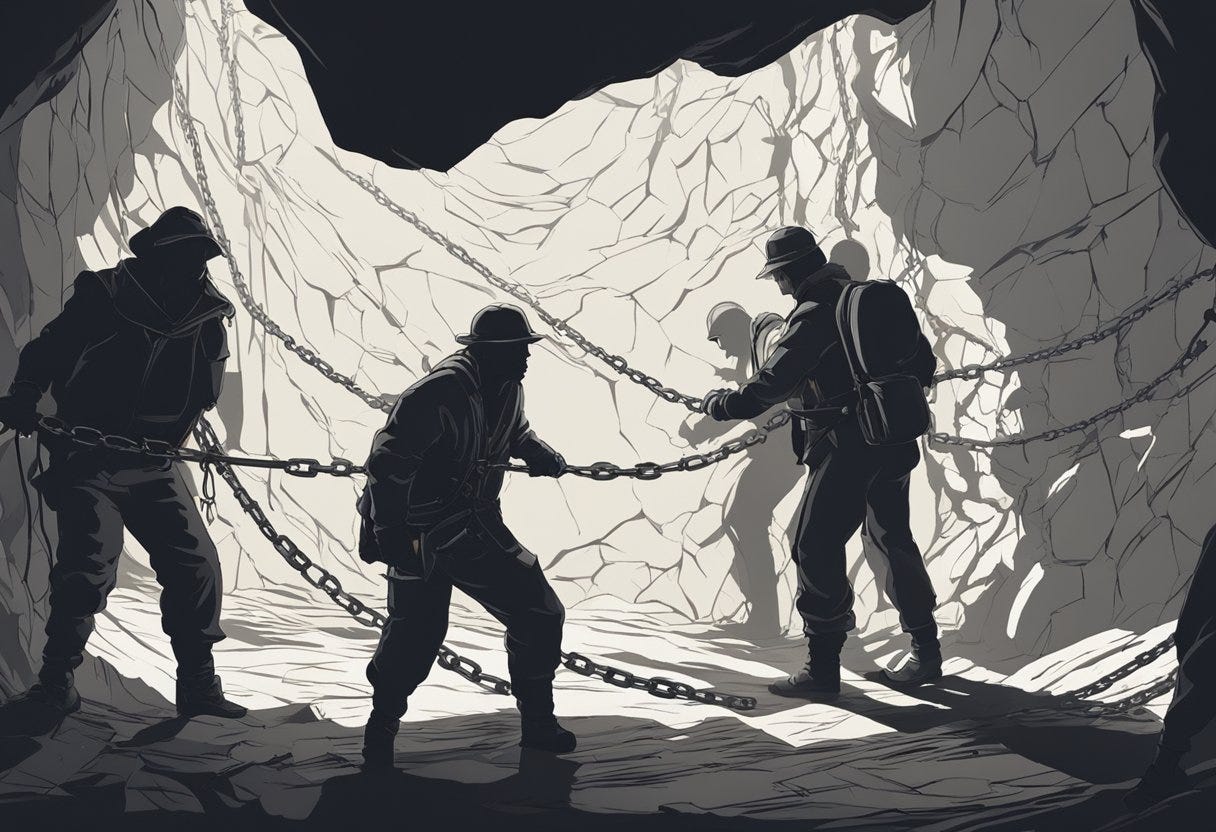
A perfect, eternal realm beyond our own. An imperfect, temporary realm in which we live. The tension between life in the cave and the images of the perfect and eternal. It is easy to see the overlap between this Platonic philosophy and Christianity. It is widely acknowledged that Plato’s thought had a significant impact on early Christian philosophy, for good or for ill. In any case, there is something in his philosophy to which we all can relate. We know things can be better, we know there is true justice, pure love, and complete authenticity, but our experience invariably falls short. This is also our experience with Christianity. We are taught, we believe, we hold by faith, that God is love and that He loves us - but we can only interpret and experience that love imperfectly. And, as we are, we can’t reliably even conceive of what perfect love looks like. And so we live by faith in what we know to be true but cannot see or fully experience. We know that perfect love has come into our cave. We live in the hope that we, one day, will experience that perfect love forever. But the hope is bittersweet, because we know we cannot have it fully now. At the same time, in the Christian story, we have the picture of Eden, where the first of us experienced the perfect realm, before we fell from it. Knowledge of the place we were made for, the experience of where we are now, the hope of rest in our true home in the future. For us, this ideal realm exists, and, instead of one of us being unchained and allowed to experience the ideal, one from the ideal realm has come to us, showing us the way to this hope of a true home.
There are no solutions, only trade-offs.
Thomas Sowell - A Conflict of Visions: Ideological Origins of Political Struggles
This tension, knowledge of the way things should be and the experience of the way things are, dominates much of our political and cultural expression. Current political and cultural movements, in particular, claim that the lack of this ideal state is a true grievance which can be blamed on our cultural and political enemies. If not for them, you could have the life you were meant to have. You and I should be living in the ideal realm of forms. All real progress is denied, all those claiming there has been progress are rejected. The imperfections of our political and cultural enemies, keeping us from that ideal realm, are fatal and irredeemable. The imperfections of all of our economic, political, and institutional expressions mean we can discard them. They fall short of the ideal realm. Burn them all down. Abolish police or incarceration or borders or armies or capitalism or alliances or trade. This was once a prominent part of the progressive movement only. Now, populists of the right and left have different versions of this sentiment. But, as I said in the The Lost City of Atlantis, there is no Utopia, not here and not yet. Or, as Thomas Sowell has written, “There are no solutions, only trade-offs.”
The Lost City of Atlantis

Now in this island of Atlantis there existed a confederation of kings, of great and marvelous power, which held sway over all the island, and over many other islands also and parts of the continent.
One of those institutions that has fallen into disrepute during my lifetime is the church, or, for some people, Christianity in general. As a result, many have discarded them. The expression of the church has fallen far short of any ideal. Scandals. Political and cultural distractions and diversions. Too often, the church, which should represent a heavenly reality, descended into the same culture wars through which we should be providing perspective and a unifying spiritual identity. At the same time, we, too often, proclaimed a spiritual identity at odds with this expression. In other words, there has been a lot of hypocrisy in the church and from the church - presenting the wildly imperfect almost as if it truly represents the realm of forms. Instead of pointing to the Solution, we have presented ourselves as the solution.
In response to this failure and other institutional failures, many people, in particular many younger people, have a deep allergy to hypocrisy. Jesus has a deep allergy to hypocrisy also, as many gospel passages attest. This is as it should be. But there is a difference between being averse to hypocrisy and committed to authenticity on the one hand and believing that people can be free from hypocrisy and fully authentic at every moment on the other hand. We live in a world where almost all institutions and organizations are seen as imperfect, short of the ideal, and therefore tainted. If we come to believe that we should not be associated with tainted institutions or beliefs or organizations, we have trouble connecting to anything, joining anything, or committing to anything. Believing in a world of solutions, we are conflicted living in a world of trade-offs. Believing in the ideal, we are conflicted living in reality. The idea that we ourselves are tainted is either impossible to admit, or it paralyzes us - disqualifying us from living and acting with agency in the real world.

I have encountered many young people who describe themselves as being caught in this trap. The descriptions I have heard most often from them in this context is “overthinking” or “in my own head.” The pull of the world of forms is real, both for themselves and for others. If a lack of authenticity is the worst of failings, the requirement is to be a perfect representation at all times, or pretend to be one. This is sometimes labeled the idealism of the young. But this is an impossible way to live. Instead of a redemptive movement from here, East of Eden, a movement of grace and hope in the midst of disappointment with ourselves and others, it is legalism, an almost Pharisaical expectation of performance from others, and, worse, ourselves. Can I try to be anything, lead anything, represent anything, when all of that trying, leading, and representing is destined to be tainted with imperfection? What often comes of this is hesitation, indecision, or paralysis.
Most younger people don’t want to be their parents. Even if they generally like and respect them, and especially if they don’t, there is something about our generation, older Gen X and younger Boomers, that is to be avoided. Much of that institutional decline happened on our watch, after all. But part of what there is to avoid is the failure of not representing our ideals perfectly, or well. Which has the taint of hypocrisy. I have some bad news. Hypocrisy is impossible to avoid completely. All of us fall short of our own ideals. Maybe my generation is uniquely hypocritical, but I kind of doubt it. In any case, all generations, because all people, have at least some hypocrisy. If that paralyzes us, we will be paralyzed. We are East of Eden, we are not in the ideal state, there aren’t solutions, only trade-offs. Don’t think that I am giving a permission structure for hypocrisy, I am not. I am simply trying to avoid hypocrisy when talking about hypocrisy - we all fall short of our ideals, beliefs, commitments at times. If recognizing that truth keeps us paralyzed, we will remain there. Avoiding that truth is just another flavor of the hypocrisy we rightly decry.
Even though many have rejected the church and Christianity, the better news is found in this story. We are not chained to the wall of a dim cave. God, author of the ideal realm, loves us enough to show us the story we are actually in.
In the past God spoke to our ancestors through the prophets at many times and in various ways, but in these last days he has spoken to us by his Son, whom he appointed heir of all things, and through whom he also made the universe. The Son is the radiance of God’s glory and the exact representation of his being, sustaining all things by his powerful word.
Hebrews 1:1-3
We have not been left in the dark, the light of the perfect realm not only has come to us, but became one of us. In the process, he gave us a true glimpse of it and calls us to it. We are called to walk the path of redemption and transformation, with the recognition that we will not walk it as he walked it - that we will fall short. We are not yet as we will be, and, until we are, we live in faith, hope, and love. We are objects of grace and we are called to offer grace to those around us.
Above all, love each other deeply, because love covers over a multitude of sins.
1 Peter 4:8
Not wanting to love hypocritically, I am to love imperfectly. Deeply, but imperfectly. Because love covers over a multitude of my sins and a multitude of yours. This is not a permission structure for hypocrisy, it is a call to get up every day and commit to, by God’s grace, in God’s strength, being only partially successful in living up to who I know I am called to be. What is the alternative? Our world answers that question every day and offers their answer to us every day. Cynicism. Despair. Nihilism. Rage. Wars of culture and politics and religion, to speak nothing of actual combat.
Instead, I can only ask: what does faithfulness look like today? What does love look like today? And I can ask knowing I will not always know the answer and I will not always live that answer out perfectly, or, depending on the day, even well. But, by God’s grace, I have tomorrow.
Love never fails. But where there are prophecies, they will cease; where there are tongues, they will be stilled; where there is knowledge, it will pass away. For we know in part and we prophesy in part, but when completeness comes, what is in part disappears. When I was a child, I talked like a child, I thought like a child, I reasoned like a child. When I became a man, I put the ways of childhood behind me. For now we see only a reflection as in a mirror; then we shall see face to face. Now I know in part; then I shall know fully, even as I am fully known.
And now these three remain: faith, hope and love. But the greatest of these is love.
1 Corinthians 13:8-13
Links
Plato’s Theory of Forms - daily-philosophy.com
A Conflict of Visions: Ideological Origins of Political Struggles - Thomas Sowell - Basic Books
The Lost City of Atlantis - The Embassy - Mike Sherman - April 20, 2025