
It's Tough Out There
When what we have tends to be some relatively constant percentage behind what we want, the problem may not be what we have.

View
There has been, in the last few months, a number of articles offering their particular theory of unhappiness. Or, perhaps it is a theory of happiness, just the other side of the coin. But many of the people profiled in these articles don’t seem happy, or seem to want us to think they are not as happy as we might imagine, given their income. These articles profile how people of a certain income, most of whom are living in New York, are getting by, or not. Comedian and writer Jeff Maurer, author of the I Might Be Wrong substack, has called it the “It’s Tough Out There” genre.
The latest incarnation is a series of NY Times articles entitled “Affording New York”. While gaining a lot of attention and readership is, I am sure, one of the desired outcome of any piece the NY Times publishes, some of the articles have gone viral for reasons that are not desired. Especially the latest one - “How a Family of 3 Lives on $500,000 on the Upper West Side”. One of the aspects of these articles is that they are in a series, all similar in tone with each other and with other articles of this genre - the good life is materially just out of reach, and that is very sad. Maurer had fun with the tone and the “emotional impact” aspect of these articles by imagining the NYT profile Job would have if he was alive today.
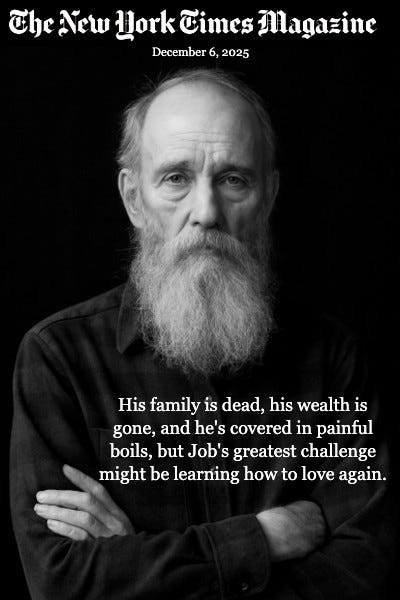
We can only be thankful that Satan did not think of this. Or maybe it wouldn’t have had quite the same effect.
I don’t really mean to sit in judgment on this family, or anyone else in the series, I want to observe something that is mostly true for most of us, most of the time. There is a gap between what we have and what we want. And what we want can be based on what those around us have or what we perceive those around us have.
In New York City, wealth is often viewed in relation to your neighbors, and many of theirs make more money. The Upper West Side has the sixth-highest median income of any neighborhood in the city, according to the N.Y.U. Furman Center.
“I think we’re middle class for this area,” Mr. O’Leary said. “We’re doing OK.”
Family of 3 - NYT - 3/25/26
Middle class for the Upper West Side, with an apartment, a small apartment to be sure, facing Central Park - is still way, way past most people reading the profile. But, because they are “middle class” compared to their neighbors, they feel … poorer.
Another example of the “Tough Out There” genre profiled separately in the Times is Gray Thurston, a 27 year-old resident of Philadelphia who makes $90,000 a year.

In this profile, Gray tells us that “Upward mobility is sort of dead.” He sees other, older people living more affluent lives. He concludes, roughly, that things are harder for his generation than for earlier generations. Again, I don’t think things are easy for young people, or for most people. But these narratives, so easy to come by in our culture, do not match any of the data. Here is a group of charts compiled from various sources by Maurer in a companion piece:
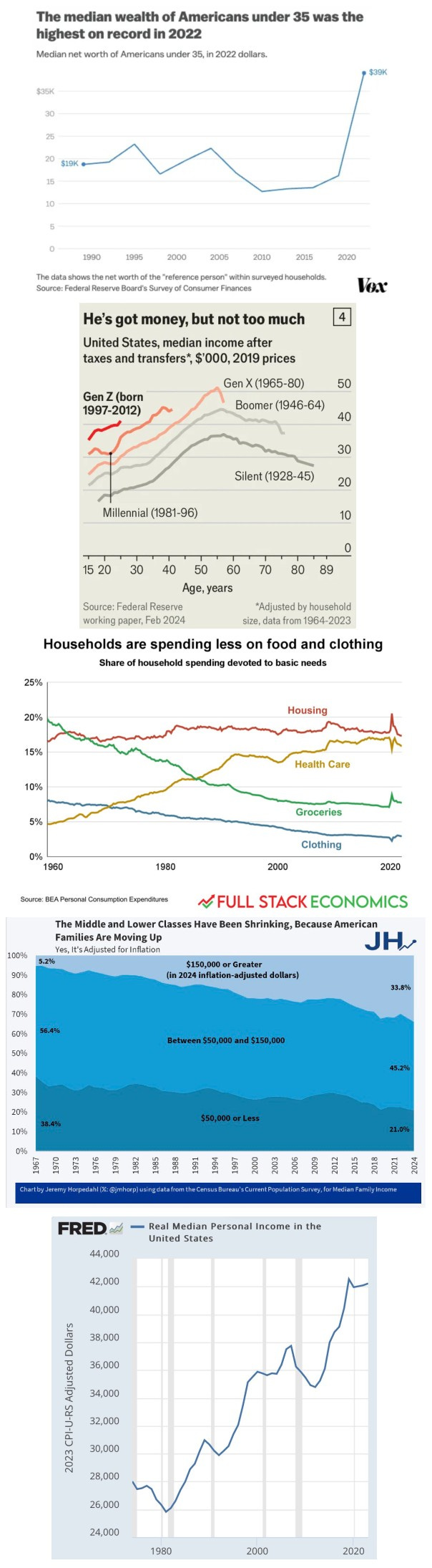
This may sound like an old man yelling at clouds. It really isn’t, at least I don’t think it is. What interests me is the narrative, the interpretation of the data that says, not that it is tough out there - it is - but that it is tougher out there than ever before, and, even, that it is tougher out there for my age cohort than for all age cohorts before me - and it is not. It is simply not. Any amount of looking at comparative economic data - all from official sources, like the charts above, and the smallest knowledge of history tells us that, however tough it is for us, it was tougher in generations before. Yet the feeling is real. I would guess that anyone who is younger reading this piece might have an internal push back going on - because, for them, it might be quite tough. Here’s the thing. Before I go on I will say it again, it is tough out there. That isn’t in question. But tough relative to what? And while we keep using the word, the definition of “tough” is a but up for grabs, isn’t it?
“Tough” might mean that we don’t have what we want. And what we want can be based on what we think we should have. Which, as the circle closes, can be based on what we perceive others have that we do not. And so on.
This is not an article on how much money we make, or should make. It is about the perpetual difference between what we have and what we want.
There have been any number of studies and surveys asking Americans how much money they need to live the life they want to live - too many to reference. In general, today’s answer is about $70,000 more - give or take. It seems not to matter what the current income is. We want, on average, $70,000 more. It is worth noting that the median annual salary in the U.S. is $62,192. So someone near the median wants to double their income. And someone making three times that wants another $70,000 on top.
Just below the surface, though, what I hear is anxiety, perhaps even the beginnings of despair. And I don’t think this is mostly about money.
This is not an article on how much money we make, or should make. It is about the perpetual difference between what we have and what we want. We seem, at the moment, to be turning the difference between those two things into a real injustice, a deep grievance - turning what we want into what we really should have, if the world worked as it ought. Just below the surface, though, what I hear is anxiety, perhaps even the beginnings of despair. And I don’t think this is mostly about money. This phenomenon reflects, I think, a fear of an uncertain future, an insecurity about the present, and a sense that all of this is precarious. Which is what happens when we are trusting in our material situation for peace, safety, security, and calm. We think if we just had another $70k per year, we would maybe not have all of these things in full, but we would have a lot more of these things - while the person making $70k more than us is entertaining exactly the same thoughts. And, since there will always be some dollar figure I do not have that I believe I need, I may rightly, by this view, respond with anger, even despair. A righteous anger, a justified despair.
I said above that “tough” might mean not having what we want, not having what we believe we should have, not having what we perceive others to have. That isn’t a great definition. We talk a lot about income inequality, where such inequality implies without trying to demonstrate that what others have leads to what I do not have. Some of this talk is a way to explain or legitimize our discontent. Which starts not with inequality, but with our discontent. There is an older word we rarely now use, envy, which may explain at least some of this perception. If it is wrong for some people to have more and some others to have less, it must be justice to take grievance that some have more - a situation that is true for almost all people at all times - it is certainly true for you and I in the present (unless Jeff Bezos or Elon Musk or Larry Ellison or Mark Zuckerberg are readers - and if so, I need to create a different subscription tier).
Envy is one of the seven deadly sins named in antiquity. Envy isn’t wanting what others have, it is wanting others to have less, it is thinking we will be happy if others have less. In our time, we seem to be trying to turn envy into a virtue. Envy as a virtue, even despair as a virtue, righteous envy, justified despair, doesn’t work, won’t work. Envy is the opposite of joy, blocking us from rejoicing when others rejoice and weeping when others weep, instead, envy causes us to rejoice when others suffer and weep when others rejoice. Envy also sucks the gratitude from us, letting us live in an ongoing victim hood, even in the face of comparative affluence. If envy is the opposite of gratitude, despair is the opposite of hope. When we survey our nation and ourselves, lacking joy, gratitude, and hope, while at the same time more affluent than the rest of the world and more affluent than earlier generations, we should reconsider envy and despair as virtues.
It may be tough out there, but we can be thankful it isn’t as tough as it might be, or that it is for others.
Take
Just a quick acknowledgement of those who take the time to comment, like, share, or subscribe. I don’t ask people to do that, because I am not monetizing any of that. For those who comment directly here on the Substack platform, I do tend to see those because I am regularly on here. I don’t think to look at the podcast platforms (Spotify or Apple), so I tend to miss those. Even so, thanks so much for your interaction with these thoughts. I am thankful for all interaction. Here is an example:
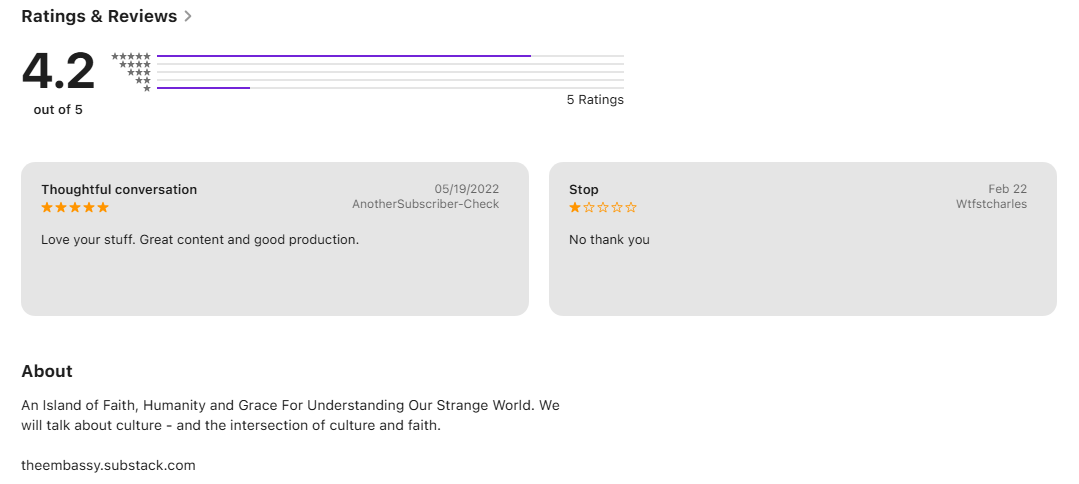
I never check Apple Podcasts - I use Spotify, normally, and, as I said, I never check that. But I appreciate both the “Thoughtful conversation” comment along with the, bonus points for brevity, “Stop”. Wtfstcharles demonstrates politeness alongside brevity, a polite brevity - “No thank you” - although that might have been a polite “no” to a question regarding the initial rating. (Thanks to my wife for finding this rating for me). I am happy for all of them, even a polite “Stop”. I prefer to think this was directed at one of my guests (Trey), but it may have been me. Anyway, Wtfstcharles, I will stop, eventually. In the meantime, I can suggest other podcasts. I would have to get in to Apple Podcasts to do that, though, and I may not get around to that anytime soon.
Links
How a Family of 3 Lives on $500,000 on the Upper West Side- New York Times - 3/23/26
The “It’s Tough Out There” Genre Has Jumped the Shark, Landed on the Shark, Rendered the Shark Quadriplegic - Jeff Maurer - imightbewrong.org - 3/25/26
Generation Z is Unprecedentedly Rich - The Economist - 4/14/24
These Young Adults Make Good Money. But Life, They Say, Is Unaffordable. - Sabrina Tavernise - 12/20/25
What Causes Economic Doomerism? - Jeff Maurer - imightbewrong.org - 12/2/25
Americans Reveal How Much Money They Need to Feel Secure—See How Your Answer Stacks Up - Katharine Paljug - Yahoo!Finance - 11/23/25
TED: The Economics Daily - The Bureau of Labor Statistics - 7/28/25
Thank you Mike. This is an important conversation to have regularly, if we don't, then we are not preparing our kids to be successful. You are right to point out that it has always been tough out there. The difference today is that we consume so much media input that says, 'You deserve this', 'here is the IT girl look', 'you are what you own'. Turn it off.
When it comes to the concept of having enough, I have had two major influences in my life. First, my parents, who never had much money, but their attitude has always been one of gratitude and contentment. What a gift that has been to me.
The other is that my husband was insistent on having a budget when we first were married, and I insisted we gave and saved. We set aside %s for savings, and giving first and used cash in envelopes set aside at each pay period for groceries, for eating out, for miscellaneous expenses... we didn't use cards. It is important to learn where you spend your money. We managed to pay out of pocket my graduate degree. We said No to funding our wants on credit unless we had a plan to pay it off in a month. When rent went up - we moved to a cheaper place.
When we both lost our jobs and healthcare in 2008, we were fortunate to have had savings set aside for the kid's college. We were able to stick it out for 9 months of mortgage payments, car payment, and Cobra health coverage (necessary as we had 2 active teenagers and more than the house and car combined) before a steady income was obtained. It made paying for the kid's education harder, but we did that too.
We didn't feel deprived. We enjoyed camping and reading, we had great travels (by car). We had average incomes for our area. Living within your means is difficult, but doable. You have to plan.
I sound like an old lady, and I am, but it is good to learn from others.