Following From Here
All Politics is Local, so is All Wisdom
View
We live in a time and place where, if we want, we can see all the big trends. Not that we shouldn’t see them, and it would be hard to ignore them if we tried. It is hard to avoid the conversations about AI. Since one of the arguments states the improvement of artificial intelligence will lead directly to our enslavement and/or death, that may be understandable. There is a trend of lawlessness in our government that seems hard to ignore. More and more people in government all across the political spectrum seem to think that, because they are right, because they are the good people, they should be able to do what they want, regardless of what the law may say. We also notice the trends regarding nationalism, or socialism, or institutional decline. On a more personal level, perhaps not unrelated to these trends, we hear that there is a declining birth rate. Or we may know people who struggle (on either side) with estrangement within their family, or broken friendships - perhaps from the fallout of the “conversation”, such that it is, around these trends.
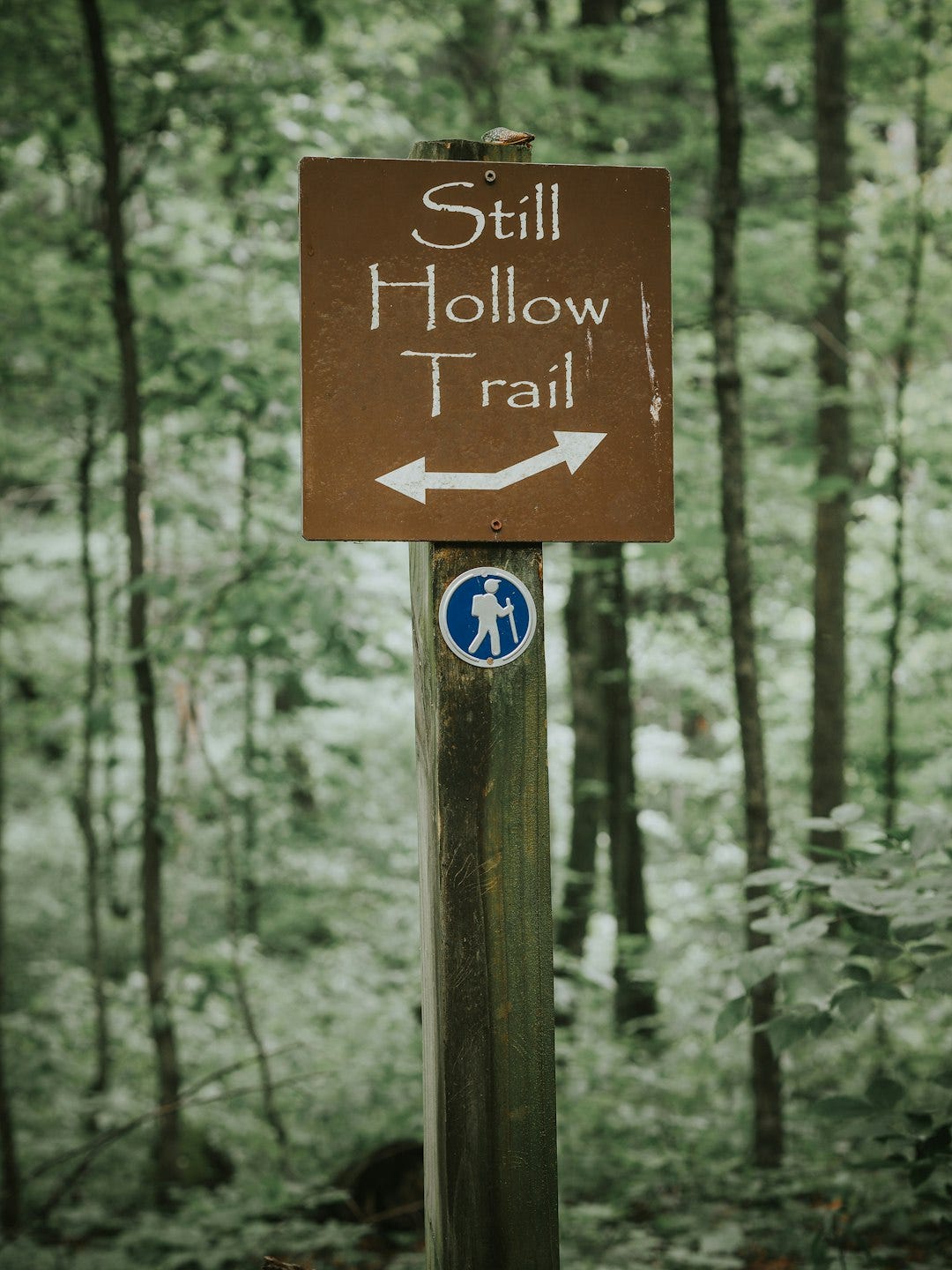
These are trends moving in the world, but how are they moving in my world, or in yours? Where, exactly, specifically, is your world and what is happening in it, or in you? And, what does living wisely look like? It partly depends on who you are and where you are and who you are with. It depends on this time and this place and these people.
We are in the season of Lent, the 40 days leading up to Easter. Christians sometimes “give up” something, or fast from something during this period. It is an act of self denial, the specifics of this act generally not dictated by Christian teaching directly, to focus us more on God, to follow Him more closely, in the most local of ways. Many people give up sweets, or more traditionally, meat (except for the allowance of fish on Fridays). Pope Leo, elevated to the office just last year, has something different in mind for his first Lenten season as Pope. He is, and is encouraging others, to fast from saying bad things about other people. He, for Lent, wants us to fast from hurtful words, gossip, and language that divides, refraining from “speaking ill about those who are absent and cannot defend themselves”. We might say this addresses none of the big trends, or we might say it addresses the biggest one, the one that impacts each of us personally, potentially every day.
We are familiar with the phrase, “All politics is local”, reflecting the belief that people are most concerned with what directly impacts their daily lives. The phrase is sometimes used ruefully by pundits, who want people to focused more on the big trends, or perhaps simply to focus more on what they are concerned with. Wisdom is also local. Love is local, even if traveling into my city or another city in another part of the world. It is proximate. It is right there in front of us, or likely it isn’t in play at all.
“If we are talking about the challenges of cultural discipleship, the strategy must fit the logistics.”
Robert Joustra - “Punching Blind” - Comment - Summer 2025
When the virtues, or our meaning, or what we hope to be about begin to more and more resemble abstractions, then who we say we are, what we think we believe also more and more resembles an abstraction. Christians talk about discipleship, which should mean a transformative process that results in us being more like Jesus, but which often comes to mean simply believing the right set of beliefs. Believing the right set of beliefs is indispensable, but, by itself, might leave us like the Pharisees of Jesus’ day - many “right” beliefs being contradicted by our very lives.

Wisdom is contextual. It is, in fact, the contextualization of knowledge and love and faith and truth. In the Torah, we notice a sometimes vague distinction between laws that are moral, or civil, or ceremonial. The moral law remains with us, we believe, because these reflect God’s character. The civil and ceremonial (though often sited in culture war settings) have been superseded. They don’t apply to us directly partly because they were contextual - they were how the moral law was to be distinctively lived in that time and place, in that part of this big story we are all in together - but a different part than we are in now. That they seem arcane to us should not be surprising, that world seems arcane to us - we are in a different time and place.
“What does it mean to follow Jesus on the construction site or in the dairy barn? What does it mean to follow Jesus in the palliative care home or during the night shift at the oncology ward? It’s hard not to feel that the grand strategies that have so far proved popular are targeted at a specific social and economic caste, one that is very much online and footloose, one that often forgets its place.”
Robert Joustra - “Punching Blind” - Comment - Summer 2025
Following from here, following now, today, involves wisdom about what loving looks like, and, for that matter, what wisdom looks like right here and right now. It will not be about being right, only, it will be about a necessary transformation in me that allows me to live these things out with love and faith and hope and wisdom. Focusing outward is part of the transformation inward. It is about others, perhaps even forgetful of me.
John Piper, an avatar for conservative Christian theology and practice for decades, recently posted on X a bible verse - Leviticus 19:34.
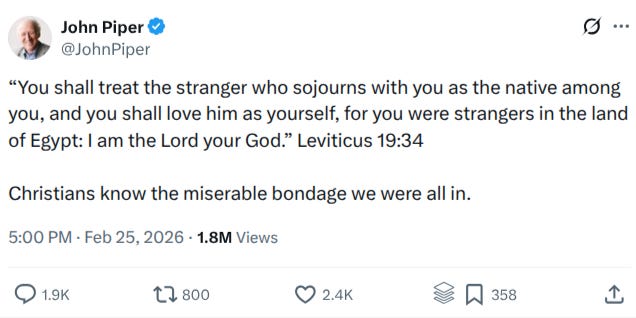
It is an attempt at applying a biblical command on an individual level. It is how I should act toward someone who is non-native to my own country, because God’s people were also sojourners, for centuries, in a foreign land. I should love them as I love myself. It is a specific application of the command to love my neighbor, or at least to love my enemies. The bondage he mentions likely refers to our former spiritual bondage.
It isn’t a statement of political policy. It is a command for how we should treat others, regardless of what the preferred, even correct, policy may be. In another time and place, in another part of the story, where different trends are at play, it would have been uncontroversial. At the same time, that we are in this time and place is likely why Piper posted it. Unfortunately, predictably, many in the politically active wing of Christian America jumped in to assure us that this did not mean we had to treat our immigrants with love. Believing they are right on the big trend, they fumble the obvious biblical direction - and begin to resemble the Pharisees who argued with Jesus out of their perceived “rightness”. This is what happens when being convinced about our rightness in the abstract overshadows (one can’t say trumps here, because of our current time and place) how we live our actual lives - loving or not loving, caring or not caring, giving or not giving - today, here and now, in this time and place. It may cause us to jump in to say that a straightforward biblical command does not mean what it plainly appears to mean. It may also cause us to speak ill (publicly) of those who are not present and are not able to defend themselves. Although I doubt Piper is very concerned with the comments.
“Much of the Christian life, much of following Jesus, is not just about the right answers; it is about prudence, about balance and proportion in responding to the excesses or idols of our particular places and times. To know how to follow Jesus where we are, we must have both books of God’s revelation wide open: the book of his word and the book of his world. We must know God’s law and how to apply it where we are. We must know, to reference Calvin’s structure of The Institutes, not only God but also ourselves.”
Robert Joustra - “Punching Blind” - Comment - Summer 2025
You may have heard that the United States men’s and women’s hockey teams both won gold at the just concluded Torino Winter Olympics, defeating the favored Canadian teams. There was much rejoicing and celebrating on this side of that border. After those happy results, what could go wrong? Well. As is often the case, divisive cultural and political factors intervened. I don’t care to comment. What’s more, I don’t know that I have, or need to have, an opinion on the matter, at least not an identity reinforcing, all the chips in the middle of the table kind of opinion. The more identity reinforcing, no matter what side of the cultural divide one is one, the more likely it is to be shared. And the more likely it is to be judgmental and condemning of those not present, not able to defend themselves. I doubt the Pope weighed in.
“The wise person knows how to pay attention - knows which features of the landscape to focus on, which is a great art, and which features to ignore, which is a greater one.”
David Brooks - Wisdom Is Not Intelligence - Comment - Summer 2025
Giving up words of a certain kind for lent might sound small. What can that do against the big trends of the world? Or, it might be a part of your transformation, a practice of building discernment and growing wisdom. This isn’t small. It is big enough that we can avoid doing it for our whole lives.
Silence is violence, we are told. Perhaps that is true, at times. It depends on the context, the logistics, the features of the landscape. Partly because of this maxim, a lot of things get said. I’m not sure the world is improving as a result. I’m not sure the people communicating the approved message are maturing as a result. Sometimes silence is golden, sometimes it is wisdom, discernment, even (perish the thought) humility. I am comfortable with my silence regarding an Olympic hockey team.
At any rate, I have to decide for myself - based on the landscape near me, based on my time and place, based what wisdom and love look like from this very particular view. Yesterday might have been different. Tomorrow, of course, things may change. But here we are today.
Links
Pope Leo calls on faithful to “fast from words” during Lent this year - Rome Reports - February 17, 2026
Robert Joustra - “Punching Blind” - Comment - Summer 2025
David Brooks - “Wisdom Is Not Intelligence” - Comment - Summer 2025